

F.K. Waechter, F.K. Waechter (Ill.)
Christian Schünemann
Otto A. Böhmer
Tomi Ungerer, Tomi Ungerer (Ill.)
Doris Dörrie
Martin Suter
Alfred A. Häsler
Walter Nigg
Urs Widmer
Walter Nigg
Sibylle Mulot
Urs Widmer
Maria Elisabeth Straub
Anne Diekmann (Hg.), Willi Gohl (Hg.), Tomi Ungerer (Ill.)
Tatjana Hauptmann, Christian Strich (Hg.), Tatjana Hauptmann (Ill.)
Johannes Carstensen, Tatjana Hauptmann
Hartmut Lange
Sibylle Mulot
Tomi Ungerer, Tomi Ungerer (Ill.)
Slawomir Mrozek, Chaval (Ill.)
Friedrich Dürrenmatt
Walter Nigg
Hansjörg Schneider
Urs Widmer
Bernd Eichinger (Hg.)
Hans Werner Kettenbach
Hartmut Lange
Tomi Ungerer, Tomi Ungerer (Ill.)
Friedrich Dürrenmatt
Hansjörg Schneider
Bernhard Schlink
Hans Werner Kettenbach
John Vermeulen
Leon de Winter
Tomi Ungerer, Tomi Ungerer (Ill.)
Leon de Winter
John Vermeulen
Donna Leon
Donna Leon
Donna Leon
Magdalen Nabb
Magdalen Nabb
Magdalen Nabb
Anthony McCarten
Magdalen Nabb
Patricia Highsmith, Paul Ingendaay (Hg.)
Ludwig Marcuse
Hartmut Lange
F.K. Waechter, F.K. Waechter (Ill.)
Friedrich Dürrenmatt
Urs Widmer
Christian Schünemann
Hugo Loetscher
Slawomir Mrozek
Friedrich Dönhoff
Christian Schünemann
F.K. Waechter, F.K. Waechter (Ill.)
Urs Widmer
Ingrid Noll
Luis Murschetz
Jakob Arjouni
Friedrich Dürrenmatt
Tatjana Hauptmann, Theodor Storm, Tatjana Hauptmann (Ill.)
F.K. Waechter, F.K. Waechter (Ill.)
Martin Suter
Lukas Hartmann
Martin Suter
Tilman Spreckelsen
Doris Dörrie
Luis Murschetz
Friedrich Dürrenmatt
Friedrich Dürrenmatt, Peter Rüedi, Urs Widmer
Slawomir Mrozek
Viktorija Tokarjewa
Hugo Loetscher
Friedrich Dürrenmatt
F.K. Waechter, F.K. Waechter (Ill.)
Christoph Poschenrieder
Friedrich Dürrenmatt
Walter Nigg
Martin Suter
Hartmut Lange
Friedrich Dürrenmatt
Bernhard Schlink
Hartmut Lange
Hugo Loetscher
Viktorija Tokarjewa
Tomi Ungerer, Tomi Ungerer (Ill.)
Ingrid Noll
Hugo Loetscher
Hartmut Lange
Tomi Ungerer
Viktorija Tokarjewa
Martin Suter
Friedrich Dürrenmatt
Sibylle Mulot
Hugo Loetscher
Friedrich Dürrenmatt
Slawomir Mrozek
F.K. Waechter, F.K. Waechter (Ill.)
Jean-Jacques Sempé, Patrick Süskind
Slawomir Mrozek
Bernhard Schlink
Ingrid Noll
Bernhard Schlink
Erich Hackl
Tomi Ungerer, Tomi Ungerer (Ill.)
Alfred Andersch
Alfred Andersch
Hans Werner Kettenbach
Hugo Loetscher
Friedrich Dürrenmatt
Bernd Eilert, F.K. Waechter, F.K. Waechter (Ill.)
F.K. Waechter
Friedrich Dürrenmatt
F.K. Waechter
Alfred Andersch
Hans Werner Kettenbach
Tatjana Hauptmann, Urs Widmer, Tatjana Hauptmann (Ill.)
F.K. Waechter, F.K. Waechter (Ill.)
Ingrid Noll
Lukas Hartmann
Christian Schünemann
Walter Heinrich
Patrick Süskind
Luis Murschetz
Sibylle Mulot
Sibylle Mulot
Tatjana Hauptmann, Franz Kafka, Tatjana Hauptmann (Ill.)
Christoph Poschenrieder
Friedrich Dürrenmatt
Martin Suter
Walter Muschg, Julian Schütt (Hg.), Winfried Stephan (Hg.)
Uwe Timm, Tatjana Hauptmann (Ill.)
Paul Flora, Paul Flora (Ill.)
Erich Hackl
Andrej Kurkow
Donna Leon
Donna Leon
Patrick Süskind
Donna Leon
Peter Rüedi
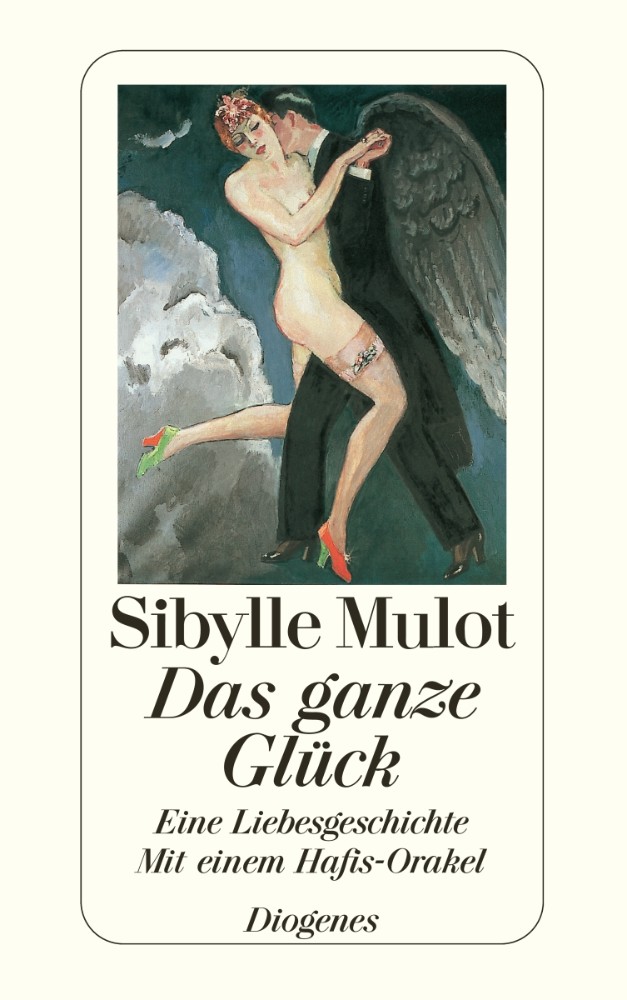
When, at last, the man of her dreams speaks to her, she turns him down. »As if a stranger were speaking through her lips.« Ferraghani is Persian, Sanda is German. They meet in Vienna as students. It is the beginning of a story as old as Romeo and Juliet. It is about the joys and terrors of great love, the embodiment of bliss and the crash into reality. Here, however, the relationship is not doomed to an untimely end through death of the protagonists; Sanda and Ferraghani are faced with the question of all failed lovers: Was their fate sealed from the beginning? Or is there a kind of happiness that cries out for destruction? A love story of shimmering eroticism and tender melancholy – as well as oriental inspiration, since the Oracle of the great Hafiz to which Sanda and Ferraghani turn is available to the reader in the appendix to the book.
»Sibylle Mulot has produced a literary masterpiece with this book about happiness - a completely rounded work in which every word has been perfectly chosen.«Frankfurter Allgemeine Zeitung
»The narrative perspective is at once refined and completely unaffected. With each new book, Mulot’s prose becomes more concise, more compact, more polished.«Neue Zürcher Zeitung
»Sibylle Mulot is a talent rare among German writers: she knows how to summon up the small dramas of everyday life with a light wave of her hand, dramas which are not infrequently echoes of the greater tragedies of the past.«Der Spiegel