

F.K. Waechter, F.K. Waechter (Ill.)
Christian Schünemann
Otto A. Böhmer
Tomi Ungerer, Tomi Ungerer (Ill.)
Doris Dörrie
Martin Suter
Alfred A. Häsler
Walter Nigg
Urs Widmer
Walter Nigg
Sibylle Mulot
Urs Widmer
Maria Elisabeth Straub
Anne Diekmann (Hg.), Willi Gohl (Hg.), Tomi Ungerer (Ill.)
Tatjana Hauptmann, Christian Strich (Hg.), Tatjana Hauptmann (Ill.)
Johannes Carstensen, Tatjana Hauptmann
Hartmut Lange
Sibylle Mulot
Tomi Ungerer, Tomi Ungerer (Ill.)
Slawomir Mrozek, Chaval (Ill.)
Friedrich Dürrenmatt
Walter Nigg
Hansjörg Schneider
Urs Widmer
Bernd Eichinger (Hg.)
Hans Werner Kettenbach
Hartmut Lange
Tomi Ungerer, Tomi Ungerer (Ill.)
Friedrich Dürrenmatt
Hansjörg Schneider
Bernhard Schlink
Hans Werner Kettenbach
John Vermeulen
Leon de Winter
Tomi Ungerer, Tomi Ungerer (Ill.)
Leon de Winter
John Vermeulen
Donna Leon
Donna Leon
Donna Leon
Magdalen Nabb
Magdalen Nabb
Magdalen Nabb
Anthony McCarten
Magdalen Nabb
Patricia Highsmith, Paul Ingendaay (Hg.)
Ludwig Marcuse
Hartmut Lange
F.K. Waechter, F.K. Waechter (Ill.)
Friedrich Dürrenmatt
Urs Widmer
Christian Schünemann
Hugo Loetscher
Slawomir Mrozek
Friedrich Dönhoff
Christian Schünemann
F.K. Waechter, F.K. Waechter (Ill.)
Urs Widmer
Ingrid Noll
Luis Murschetz
Jakob Arjouni
Friedrich Dürrenmatt
Tatjana Hauptmann, Theodor Storm, Tatjana Hauptmann (Ill.)
F.K. Waechter, F.K. Waechter (Ill.)
Martin Suter
Lukas Hartmann
Martin Suter
Tilman Spreckelsen
Doris Dörrie
Luis Murschetz
Friedrich Dürrenmatt
Friedrich Dürrenmatt, Peter Rüedi, Urs Widmer
Slawomir Mrozek
Viktorija Tokarjewa
Hugo Loetscher
Friedrich Dürrenmatt
F.K. Waechter, F.K. Waechter (Ill.)
Christoph Poschenrieder
Friedrich Dürrenmatt
Walter Nigg
Martin Suter
Hartmut Lange
Friedrich Dürrenmatt
Bernhard Schlink
Hartmut Lange
Hugo Loetscher
Viktorija Tokarjewa
Tomi Ungerer, Tomi Ungerer (Ill.)
Ingrid Noll
Hugo Loetscher
Hartmut Lange
Tomi Ungerer
Viktorija Tokarjewa
Martin Suter
Friedrich Dürrenmatt
Sibylle Mulot
Hugo Loetscher
Friedrich Dürrenmatt
Slawomir Mrozek
F.K. Waechter, F.K. Waechter (Ill.)
Jean-Jacques Sempé, Patrick Süskind
Slawomir Mrozek
Bernhard Schlink
Ingrid Noll
Bernhard Schlink
Erich Hackl
Tomi Ungerer, Tomi Ungerer (Ill.)
Alfred Andersch
Alfred Andersch
Hans Werner Kettenbach
Hugo Loetscher
Friedrich Dürrenmatt
Bernd Eilert, F.K. Waechter, F.K. Waechter (Ill.)
F.K. Waechter
Friedrich Dürrenmatt
F.K. Waechter
Alfred Andersch
Hans Werner Kettenbach
Tatjana Hauptmann, Urs Widmer, Tatjana Hauptmann (Ill.)
F.K. Waechter, F.K. Waechter (Ill.)
Ingrid Noll
Lukas Hartmann
Christian Schünemann
Walter Heinrich
Patrick Süskind
Luis Murschetz
Sibylle Mulot
Sibylle Mulot
Tatjana Hauptmann, Franz Kafka, Tatjana Hauptmann (Ill.)
Christoph Poschenrieder
Friedrich Dürrenmatt
Martin Suter
Walter Muschg, Julian Schütt (Hg.), Winfried Stephan (Hg.)
Uwe Timm, Tatjana Hauptmann (Ill.)
Paul Flora, Paul Flora (Ill.)
Erich Hackl
Andrej Kurkow
Donna Leon
Donna Leon
Patrick Süskind
Donna Leon
Peter Rüedi
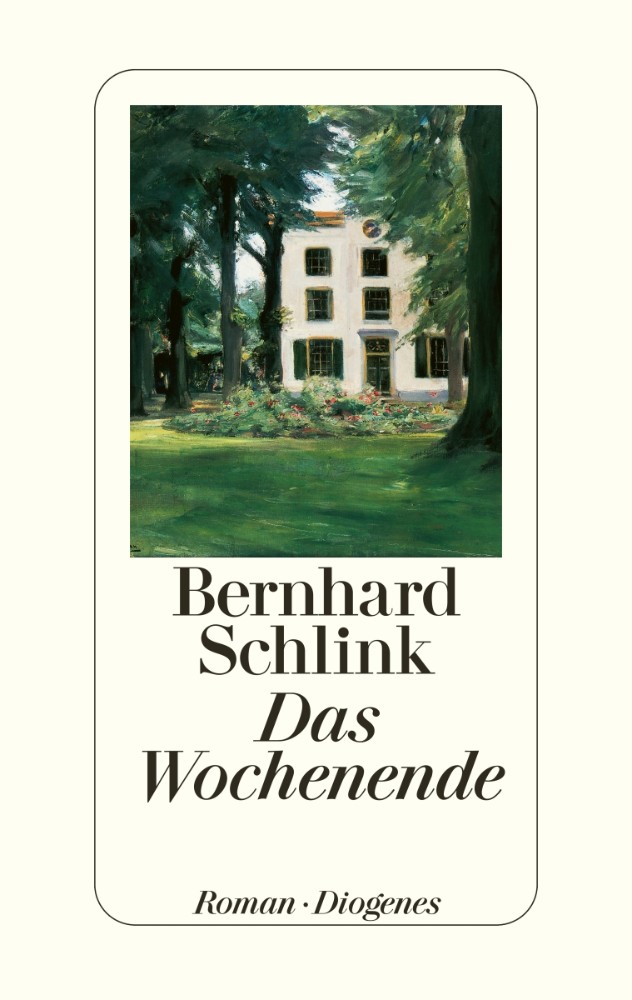
After twenty years in prison, he is unexpectedly pardoned. Christiane, his sister, wants to celebrate his first weekend of freedom with a dozen old friends in a run-down villa in the country, without reporters and cameras. Henner, a journalist, Ilse, a teacher, Ulrich, a businessman, accompanied by his wife and daughter, Karin, the bishop of a small country church, Andreas, an attorney – they all supported the revolution in one form or another at that time. Today, they have their established place in bourgeois society. They come out of loyalty, nostalgia, curiosity. They would like to advise and help and, at the same time, keep their distance. But they are not able to avoid a confrontation with their own biographies, life dreams and lies. The past comes to life. Accounts are settled in the atmospheric intensity of a drawing room theatre. ›The Weekend‹ is sold to: France (Gallimard) Spain (Anagrama) Netherlands (Cossée) Italy (Garzanti) Finland (Söderström) Greece (Kritiki) Portugal (ASA) Turkey (Dogan Egmont) Poland (Muza) Slovenia (Cankarjeva Zalozba) Bulgaria (Locus) Israel (Kinneret-Zmora-Dvir) Korea (IRE) Brazil (Record) Serbia (Plato) Macedonia (Ili-Ili) Albania (Botimet Dudaj) Taiwan (Crown) China (Shanghai Translation) Japan (Shinchosha) Croatia (Algoritam) Romania (Polirom) Russia (Azbooka) Iran (Forough) Vietnam (Vipen)
»Schlink has won his huge popular following by bringing to bear a penetrating intelligence about the psyche of his characters and an empathy for their dilemmas. Professor Schlink may be an expert on the letter of the law, but writer Schlink is an intrepid explorer of the much trickier terrain of the human heart.«Newsweek
»Bernhard Schlink finds the open sore in Germany’s present.« Süddeutsche Zeitung
»Schlink must be on the syllabus of schools as well as of political parties. Not because he tears open old wounds, but because he heals them the right way.« OÖNachrichten
»Bernhard Schlink has a keen sense of topical issues. He has chosen his characters well and has given each an individual voice.« Focus
»Transcending the political, the author creates a tangled web between his characters, which reminds of a chamber drama and provides more insights into the connection between ideology and violence than any political analysis. The patterns Schlink uses to explain the escalation of terror during the 60s and 70s are basic and apt and therefore convincing. The author of the world famous ›The Reader‹ creates well-rounded and vivid characters as usual, providing a setting from which the reader can withdraw neither emotionally nor intellectually.« Die Welt
»Schlink lets his characters meet in the atmosphere of an intimate play ... In addition to that there is the brilliant constellation of characters and Schlink’s clever dialogues. This combination makes ›The Weekend‹ an impressively dense novel.« Abendzeitung
»Exciting, at times even breathtaking, and above all stimulating, is this view of the debate on the release of RAF terrorists, which Schlink chooses in ›The Weekend‹.«Westfälische Rundschau