











Andrej Kurkow
Andrej Kurkow
Anna Dankowtsewa
Hugo Loetscher
Alfred Andersch
Erich Hackl
Friedrich Dönhoff
Fanny Morweiser
Friedrich Dönhoff
Loriot
Margaux de Weck (Hg.), Daniel Kampa (Hg.), Anna von Planta (Hg.)
Friedrich Dürrenmatt, Monika Stefanie Boss (Hg.), Margaux de Weck (Hg.), Kati Hertzsch (Hg.), Winfried Stephan (Hg.), Anna von Planta (Hg.), Ulrich Weber (Hg.)
Yadé Kara
Bernhard Schlink
Walter Popp, Bernhard Schlink
Bernhard Schlink
Ingrid Noll
Viktorija Tokarjewa
Leon de Winter
Urs Widmer, Paul Flora (Ill.)
Anthony McCarten
Matthias Matussek
Hansjörg Schneider
Viktorija Tokarjewa
Tomi Ungerer, Tomi Ungerer (Ill.)
Patricia Highsmith, Paul Ingendaay (Hg.)
Martin Suter
Andrej Kurkow
Lukas Hartmann
Liaty Pisani
Magdalen Nabb
Martina Borger, Borger & Straub, Maria Elisabeth Straub
Bernhard Schlink
Walter Nigg
Loriot
Liaty Pisani
Benedict Wells
Anthony McCarten
F.K. Waechter, F.K. Waechter (Ill.)
Paul Flora, Paul Flora (Ill.)
Urs Widmer
Patricia Highsmith, Paul Ingendaay (Hg.)
Slawomir Mrozek
Donna Leon
Leon de Winter
Esmahan Aykol
Viktorija Tokarjewa
Viktorija Tokarjewa
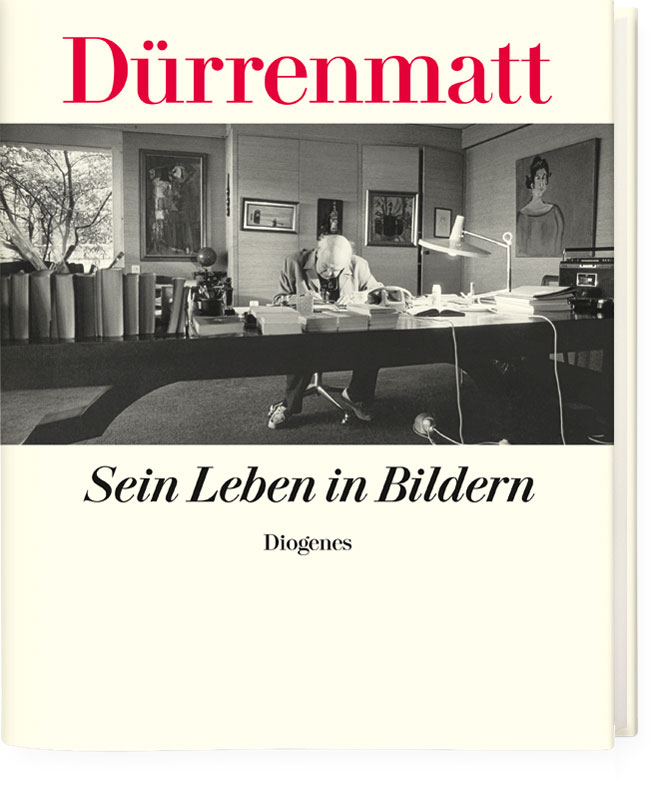
When Friedrich Dürrenmatt was a child, his parents told him the Greek myths and the stories of the Old Testament. These became the essentials of his future artistic material. A student of literature and philosophy in Switzerland spared by the cruelties of World War II, Dürrenmatt imagined the apocalypse in expressionistic paintings and in a first play, which scandalized the Swiss and made Dürrenmatt into a household name. In 1952 he moved with his wife and children to Neuchâtel. It was here, in peace and solitude, that he wrote his internationally acclaimed plays (›The Visit‹, ›The Physicists‹) and his bestselling crime novels (›The Judge and his Hangman‹, ›The Pledge‹). His late works, considered by many as his crowning achievement, are yet to be discovered by a large audience. Hundreds of unpublished photographs from the writer’s private archives are juxtaposed and ›commented‹ by excerpts from Dürrenmatt’s autobiographical works and interviews. A fantastic and vivid life in pictures.
»This biographical photo album is also a tour round cultural and theatrical history – and not only that of Switzerland. We spent hours leafing through it, reading, and looking and thinking: What a treasure trove! What a cosmos it contains! And we admit: we revelled in it! «Aargauer Zeitung
»It is only a few weeks ago that Peter Rüedi’s authoritative Dürrenmatt biography was published by Diogenes – and the picture album now extends this written account to look at the visual universe of what was an exceptional life story: outwardly rather uneventful, but inwardly explosively exceptional.«Frankfurter Allgemeine Zeitung
»Dürrenmatt was a spiritual colossus in this world, and still is. Just how colossal this colossus was is made clear by the large-format book ›Friedrich Dürrenmatt. His Life in Pictures‹.«St. Galler Tagblatt
»Some 650 illustrations show the writer and his environment, and then there are documents and numerous paintings and drawings, surrounded by biographical quotations, mainly from his ›Stoffe‹, and tied together by intelligent and useful linking texts by Margaux de Weck, which enable even readers who are quite unfamiliar with Dürrenmatt to quickly find their way. So the book is an introduction to his life and work, a visual complement to both (and to Rüedl’s long biographical essay) - and above all a huge pleasure to read and to look at.« Tages–Anzeiger