Home
  • Leser:innen
  • Presse
  • Buchhandel
  • Foreign Rights
  • Film Rights
  • Theaterverlag
toggle menu
  • Books
  • Authors
  • Reprint Inquiries
  • About Diogenes
  • Catalogues
  • ←
  • Books
  • Authors
  • Reprint Inquiries
  • About Diogenes
  • Catalogues
  • Bereiche
    • Leser:innen
    • Presse
    • Buchhandel
    • Foreign Rights
    • Film Rights
    • Theaterverlag

Search results „Eine andere geschichte”

Blogposts (506)

»Es geht nicht um Geschichte, sondern um Geschichten.« Charles Lewinsky im Interview

from 26/08/2020

Heisse Zeiten, heisse Geschichten

from 09/04/2015

Zu Ostern ein gutes Buch: Geschichten, die Frühlingsgefühle erwecken

from 27/03/2026

Yorn - Zum Muttertag, die Geschichte eines ganz besonderen Geschenkes

from 10/05/2020

»Die Geschichte, die mir vorschwebte, gab es nicht – also musste ich sie selber schreiben.«

from 26/02/2016

»Die Geschichte wiederholt sich.« Ein Interview mit Sasha Filipenko

from 25/02/2023

Weihnachten im Taschenbuch – Geschichten für die Adventszeit

from 29/11/2024

»Bei all meinen Recherchen und Erkenntnissen über Isidors Leben hatte ich das Gefühl, ich gebe ihm eine Geschichte – SEINE Geschichte zurück.« Ein Interview mit Shelly Kupferberg - Teil 1

from 21/10/2022

Mag ich / Mag ich nicht – heute mit: Solomonica de Winter

from 04/11/2014

Astrid Rosenfeld »Sing mir ein Lied« – Die Geschichte hinter dem Buch

from 17/12/2014

Amélie Nothomb ›Der belgische Konsul‹: Ein berührender Blick auf die Geschichte ihres Vaters

from 07/07/2023

Astrid Rosenfeld: »Sing mir ein Lied. 9872 Meilen und eine Geschichte«

from 28/11/2014
More blogposts

Books and authors (3)

Filter
Author (1)→
Genre (1)→
Age →
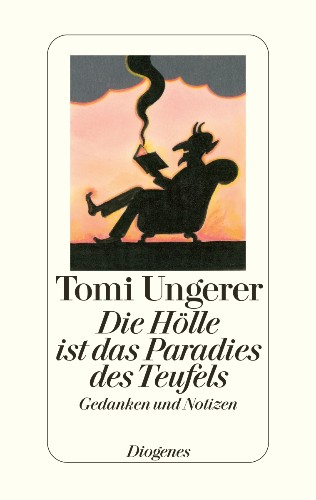
Die Hölle ist das Paradies des Teufels
Im Warenkorb
Tomi Ungerer

Useless Thoughts

Apart from ideas, sketches and drawings, Tomi Ungerer's notebooks show his predilection for aphorisms, puns and little stories. Out of this reservoir, a book has emerged for the first time which shows Tomi Ungerer's unusual side, which, however, is perhaps not that unusual after all: »I am a note-taker. I draw what I write down and I write down what I draw in order to express my thoughts clearly and succinctly«, as Ungerer himself puts it.

Further readings
  • Fact sheet PDF
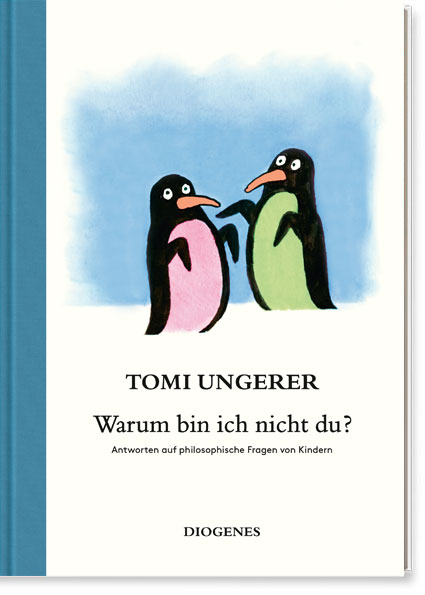
Warum bin ich nicht du?
Im Warenkorb
Tomi Ungerer

Why Am I Not You?

Tomi Ungerer answers children’s questions with the irreverent wisdom of a great artist who has never forgotten his inner child. The column from ›Philosophie Magazine‹ – in book form for the first time. »Why am I not you, and why are you not me? Who created God? If someone hits me, is it ok to hit back? Why does money exist? Could it be that I am only dreaming my life? Is there such a thing as nothing? Why do we have to love others and not just ourselves?« The great philosophical questions remain the same, be it two thousand years ago or yesterday, whether we are eighty or eight years old. Tomi Ungerer, the world-famous artist and children’s book writer, is also an idiosyncratic thinker and an untiring champion against prejudice and narrow-mindedness. Children from France and Germany asked him their questions. Ungerer’s answers are surprising, cheeky, funny, thought-provoking – and always inspiring. A philosophy book that makes readers want to think – whether they are children or adults.

Further readings
  • Fact sheet PDF
  • Extract in German
Isabel Koellreuter

Isabel Koellreuter

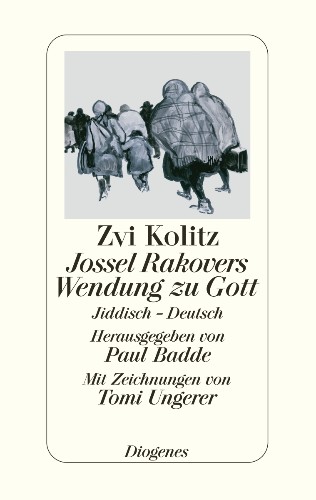
Jossel Rakovers Wendung zu Gott
Im Warenkorb
Zvi Kolitz, Tomi Ungerer, Ungerer, Tomi

Yosl Rakover Talks to God

The Warsaw ghetto is in flames, only a few Jews are still alive. One of the last insurgents, Yosl Rakover, remains hidden in a burning house. With his fallen companions at his side and death swiftly approaching, he writes down the feelings of one of a million Jews whose family has been murdered in the Holocaust, whose people have been annihilated. Alongside all of the pain that he has suffered, he describes his longing for revenge and the sweet gratification at the sight of the dying enemy. In harsh words, Yosl Rakover takes to task his God, who has turned His back on the world; but despite all of these tests and punishments, he holds fast to his faith: In the final analysis, Rakover addresses God as a faithful believer but not an indebted petitioner, a lover of God but not a blind Amen-sayer. Originally a work commissioned by the Jewish Newspaper in Buenos Aires, 'Yosl Rakover Talks to God' established itself in its own right in remarkable fashion following its initial publication in the year 1946. For many years, the text, translated into countless languages, was purported to be an authentic document from the Holocaust – in anthologies, newspapers and radio broadcasts. In 1962, Emmanuel Levinas devoted an entire study to it, while the text was included in the Jewish prayer book in America and found its way into schoolbooks in Germany. The myth concerning the origin of the text continues to blossom. One hears that the manuscript was written by an anonymous author, or that the text is a work of fiction but that Yosl Rakover did indeed exist. Kolitz' attempts to remind the world of his authorship, which he had never denied, were mostly in vain – the myth is seemingly written in stone. After the library in Buenos Aires, where the original manuscript was rediscovered, was destroyed by fire as a result of a bomb attack, the fictitious history of Yosl Rakover's testament appeared to have found its analogy in reality.


Further readings
  • Fact sheet PDF

  • Contact
  • Reprint Inquiries
  • Newsletter
  • Blog
  • Facebook
  • Twitter
  • YouTube
  • Instagram
  • Mastodon
  • Leser:innen
  • Presse
  • Buchhandel
  • Foreign Rights
  • Film Rights
  • Theaterverlag
  • Privacy Policy
  • Terms of Use
  • Imprint
↑